Tenants and objectors are concerned about how required heritage report was ignored in adjacent massive River Club development
The provincial government plans to allow five-storey buildings and more than 1,300 housing units to be built within the Oude Molen Eco-Village alongside the Black River, but their required Heritage Impact Assessment has been turned down.
The Heritage Impact Assessment, the first regulatory step for development approval, was rejected by Heritage Western Cape, the provincial authority of the South African Heritage Resources Agency, in April this year.
The provincial Department of Infrastructure, which owns the land, appealed the decision, but their appeal was dismissed by Heritage Western Cape on 10 June.
Despite the ruling, the provincial government will continue with other statutory application processes, said Western Cape Department of Infrastructure spokesperson Melchior Botes.
One of these would be the province’s rezoning application lodged with the City of Cape Town in order to change Oude Molen’s current Utility zoning to Mixed Use, Residential, and Open Space zoning.
This was because, despite Heritage Western Cape’s ruling, the department “retains the firm stance that all requirements of Section 38 of the National Heritage Resources Act have been comprehensively met,” stated Botes.
“Securing development rights for this critical property remains a priority,” he stated.
“We will be following the appropriate legal and administrative avenues to address the Heritage Western Cape decision, ensuring that all our ongoing developmental steps remain entirely lawful, transparent, and compliant with statutory frameworks.”
But the Observatory Civic Association, which is one of a number of organisations objecting to the current development plan as envisaged in the Heritage Impact Assessment, believe the province continuing with its rezoning application without an approved heritage assessment, is a violation of the National Heritage Resources Act.
The Act states the “responsible heritage resources authority” must decide whether or not the development may proceed, or whether any limitations must be set or compensation must be given.
“The development as proposed cannot be considered as the Heritage Impact Assessment does not meet the requirements of Section 38(3) of the NHRA,” stated Heritage Western Cape assistant director for professional services Waseefa Dhansay.
The section Dhansay referred to covers seven points, among them the assessment of the impact of the development on heritage resources; an evaluation of the impact of the development on heritage resources relative to the social and economic benefits of the development; and the results of consultation with communities affected by the proposed development.
The section also deals with proposed alternatives if heritage resources would be adversely effected, and plans for mitigation of adverse effects during and after development.
Award winning concept ignored
Tenants at Oude Molen who have for decades been paying rent to the province, believe their inputs and comments provided over a number of years, have not been considered.
Hudson McComb has been involved since the inception of the eco-village. He proposed the eco-village model and got reluctant buy-in from the province as owners in the mid-1990s as a way of fixing the old Valkenberg psychiatric hospital buildings which had been decommissioned post-1994 because they were part of the old apartheid segregated system. The buildings had been left to be vandalised and were barely habitable. Tenants had to spend their own money fixing them before moving in.
McComb, who managed rental collection and payment, as well as upgrades and maintenance in the eco-village until 2001, and still pays rent for the house at Oude Molen which he fixed up at his own expense, said they’ve had three consultations with different companies contracted by the province to conduct the public participation process.
“I don’t see any of that filtering into the outcome they’re proposing,” said McComb.
“So I don’t think you should take it too seriously when they’re saying they have a public participation process.”
As far back as 2010 McComb developed a proposal for Oude Molen in which the province remained the custodian of the land and the existing building footprint was maintained and improved by adding extra floors for owners and employees of light industrial enterprises such as steelworks, blacksmith forges, pottery, carpentry and cabinet makers, engravers, etc. Permaculture farming, educational and care institutions – all of which currently exist at Oude Molen – were also included, along with markets and arts and culture initiatives. He said he mixed and matched best practices from precincts as diverse as the V&A Waterfront and Spier wine farm and Lynedoch eco-village, among others.
His proposal was included as one of those in the City of Cape Town’s successful bid for World Design Capital in 2014. It was also recipient of the prestigious Sudley Adams Memorial Award in the Mail&Guardian Greening the Future Awards in 2016.
Instead of refining and implementing the proposal, the province intends to sell the land to developers. Documents forming part of the province’s unsuccessful Heritage Impact Assessment clearly state the site “will in all likelihood be packaged for largely private sector development”.
“They’ll sacrifice heritage for income when they could make income from heritage, but they don’t think that way,” said McComb.
He said he believes the Oude Molen Eco-Village, as a non-profit company, could be a site for best practice for disciplines such as architecture, water management, urban farming, indigenous heritage, and other practices. As such it could bring in R1-billion or more in tourism and related investment annually, he said, in the same way Kirstenbosch attracts tourists who also spend money elsewhere. Whereas the “concrete jungle” proposed by the province could only bring in an initial amount from the sale of the land, and a set amount of tens of millions of rands in rates and services per year thereafter, and no more.
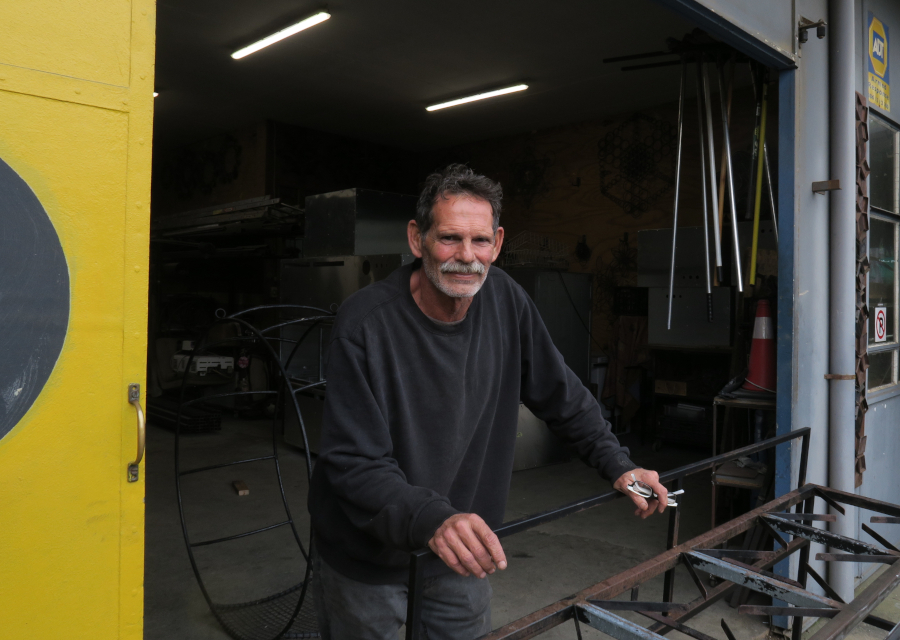
Dan Neser lives at Oude Molen where he runs a steelworks and organic produce deli. He believes the provincial Department of Infrastructure has not consulted with the tenants and interested and affected parties in good faith.
The River Club warning
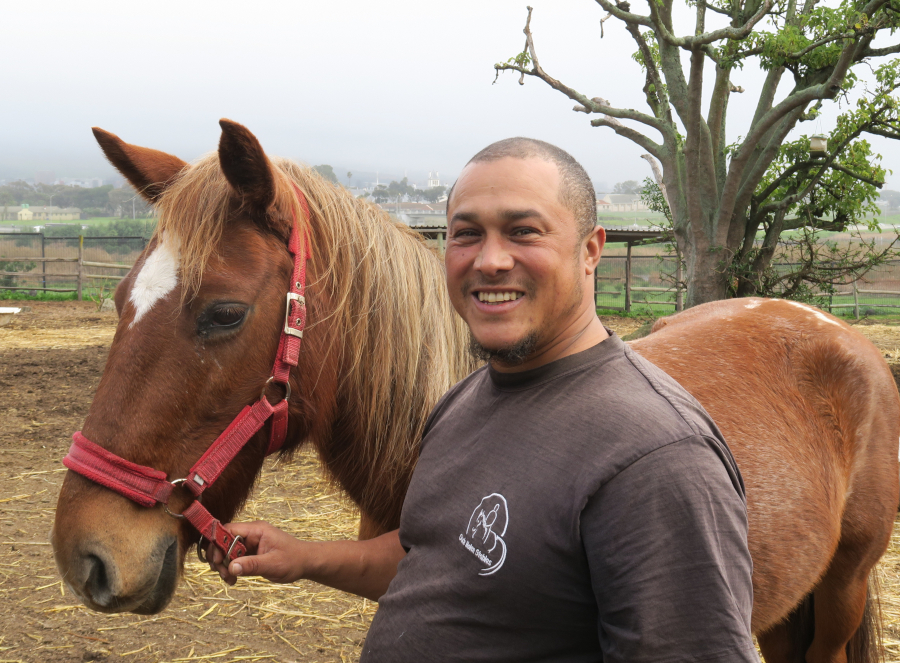
Other long term tenants, such as Dan Neser, who lives at Oude Molen where he runs a steelworks and organic produce deli, and Kendre Allies who rescues horses and provides equine therapy, also don’t see the vision espoused by the majority of tenants reflected in the province’s plans.
Unbidden, they, and other tenants and employees of the approximately 50 enterprises at Oude Molen, expressed concern the province would simply impose their wishes on the precinct as had happened at the River Club just across the Black River.
In 2020, despite the developers of the nearby River Club not getting their Heritage Impact Assessment signed off by Heritage Western Cape, the provincial Department of Environmental Affairs and Development Planning (DEADP) gave the River Club owners Liesbeek Leisure Properties Trust the environmental authorisation to move ahead with their rezoning applications.
The River Club development, on land of high heritage value being the site of original dispossession of the Khoi people by the imperial Dutch East India Company, was vehemently opposed in its presented form by the Goringhaicona Khoi Khoin Traditional Indigenous Council and the Observatory Civic Association. However, the provincial government and the City of Cape Town used taxpayers money to pay lawyers to back Liesbeek Leisure Properties in their extensive court action.
Later, in September 2022, the City-appointed Municipal Planning Tribunal decided the River Club could be rezoned from Open Space to various Business designations. This was despite, by its own admission, not having considered Heritage Western Cape’s appeal, nor that of the City’s own environment department. There were also 180 objections from civil society bodies, activist organisations, and First Nation groupings.
The River Club development, called Riverlands, is now almost complete. It features shopping centres, a Virgin Active gym, multi-million rand apartments, offices and the African headquarters of multi-national company Amazon on land that was considered sacred to First Nation people, without a Heritage Impact Assessment ever having been approved.
The Oude Molen tenants said their only hope was the fact that the eco-village was tenanted and not already owned by a private developer, might prevent Oude Molen going the same way.
Botes stated: “We will be following the appropriate legal and administrative avenues to address the Heritage Western Cape decision, ensuring that all our ongoing developmental steps remain entirely lawful, transparent, and compliant with statutory frameworks.”
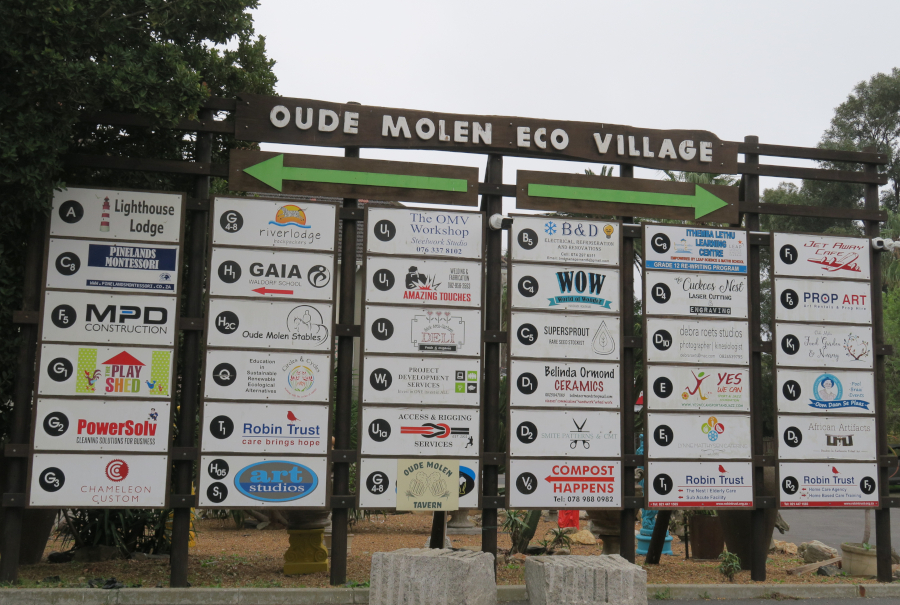
A board at the entrance to Oude Molen Eco-Village showing the numerous and various enterprises on the premises which employ between 300 and 400 people depending on the season. Some, such as Robin Trust, offer care to dementia patients and those recovering from surgery. There are also schools and community-based enterprises.
All documents and objections to the development are available at https://www.westerncape.gov.za/infrastructure/documents under Public Information, and Projects.
Comment and objections to the Development Application Notice lodged with the City of Cape Town for rezoning can by made via http://www.capetown.gov.za/LandUseObjections until 30 June.