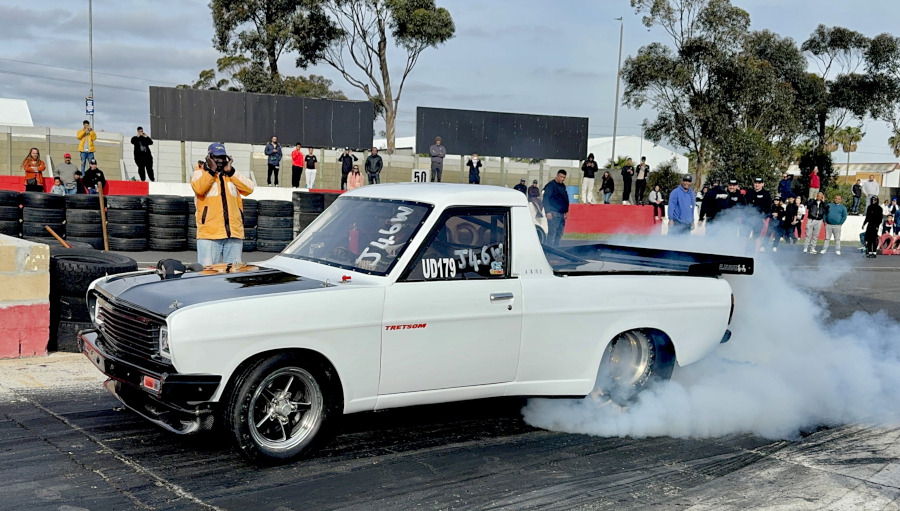
Appearances can be deceptive, especially when it comes to the world of drag racing.
Most people expect fire-breathing V8s, purpose-built race cars, so when a humble Nissan Champ bakkie pulls up to the start line, most would not expect it to be a serious contender. After all, when we think bakkie we think about tradesmen, not trophies.
Then the lights go from amber to green and Hermann Mostert’s bakkie shunts off the line to hit the 60-foot mark in 1.1 seconds (the launch makes all the difference), and cover the quarter-mile in a searing 7.72 seconds at over 270km/h, setting the record for a car in its class at Killarney last weekend.
The Nissan goes by the name of Straathond and, like many a pavement special, it punches way above it’s weight. Hermann names all his cars after dogs in fact, with his other Nissan Champ called Jack Russell. Small but fearless, these dogs possess an almost unreasonable confidence when confronting much larger opponents.
Bobby Nitro spoke to man behind the wheel Hermann Mostert, one of South Africa’s most legendary drag racers. Curiously, despite his success, Hermann has maintained a remarkably low public profile. While many modern racers build brands around themselves, Hermann has built a reputation. Simply put, he’s the only driver to have run a 7-second pass at every major drag strip he has raced at across South Africa.
Asked about now being in the limelight, Hermann says: “I don’t go for the fame really. I’m more comfortable alone, me in my bakkie. With that quarter-mile stretched out in front of me, in those seven seconds my mind is clear, nothing but the car and the track.”
As for his choice of the small Nissan, Hermann says: “It’s cute man, and it’s the most beautiful car they ever made.” So, chosen for its looks but given serious power through a Toyota 2 JZ turbocharged powerplant and, in the case of Straathond, a bespoke chassis designed and built by Hermann and his friend Richard Marks. This chassis comes in at 160kg lighter than Jack Russell.
The now even lighter bakkie provides an ideal platform for Hermann’s team to chase that optimal power-to-weight ratio. With the strong block of Toyota’s legendary 2JZ, a powerplant renowned for its capacity for customisation and raw power, Straathond produces in the region of 1500 horses but, says Hermann: “We can only ever use about 1000 HP, any more and it starts spinning.” It’s one thing to have the power on tap, laying it down to the tar is the tricky aspect of this sport. This situation, of course, is determined by the length of track that has been prepared with Trackbite. The conditions at Tarlton recently allowed Straathond to record its fastest-ever pass at 7.7 seconds flat.
But horsepower alone does not create a seven-second car. No amount of budget can do that either. What it takes is a tight team and countless hours of solving problems. Stuff breaks all the time in motorsport. Diffs, gearboxes, suspension geometry is revised for each track condition. Projects like these evolve over years of experimentation, setbacks, persistence and a determination to shave off that next tenth of a second. Hermann says: “The goal is 7.5 seconds, and we are now going to do some work on Jack Russell to get there. We are planning a custom chromoly chassis, a little wider to accommodate for wider wheels and significantly lighter.
Bobby Nitro had to know about those last moments just before the lights go from amber to green. Hermann says: “I focus on nothing else but the track. We try to run it by the book, but that never happens. For instance, the car might start spinning through second and third so I have to tap off a bit, which is not ideal. Every now and again someone offers to put a camera in with me but I say no. I don’t want people to see how I vloek the k@k out of the bakkie on the run!”
His advice to newcomers raises a smile, as he says: “Run away, don’t even start with this, or know that it will get expensive once you are hooked.”