Third-placed driver later recruited by Russian intelligence
By Glenn Hollands
Wealthy American heir Michael Straight borrowed a bi-plane to fly about 11 000 km to compete in the first South African Grand Prix held in East London (now KuGompo) in 1934.
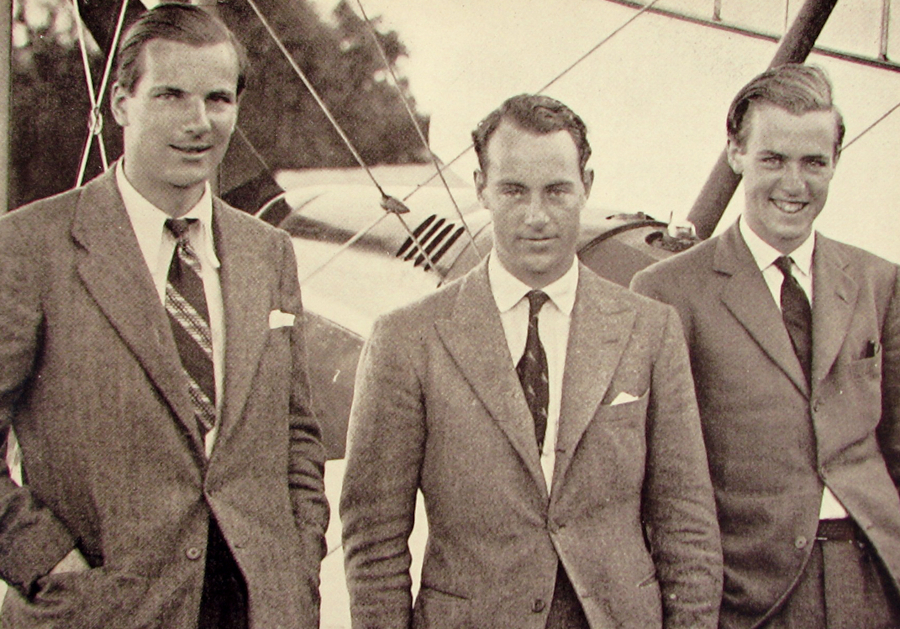
The aircraft, pictured here at the Woodbrook airfield, was piloted by Michael’s bother Whitney who raced to victory at the iconic race. The Straight brothers were joined by Richard Seaman and took off from London on 9 December 1934, arriving in East London nearly two weeks later. Stops along the way included Marseilles, Cairo and finally Salisbury where Whitney clipped a fence post on take-off and nearly ended their racing ambitions.
The same year he raced in KuGompo, Michael joined the Communist Party at Cambridge. However, also crammed into the overloaded plane was the towering Seaman. Although of a similar Cambridge background and affluent family, ‘Dick’ Seaman would join the Mercedes Benz Silver Arrows racing team two years later and had no problem being associated with the Hitler’s Nazi party. After winning the German Grand Prix in Nürburgring On 24 July 1938, Seaman took to the podium and in full view of international media, raised his arm in the notorious Nazi salute.
He died of burns from a motor racing accident a year later. At his London funeral Hitler sent an enormous wreath decorated with Nazi insignia. Just two months later WWII began.
Michael Straight’s politics took him in the opposite ideological direction. He was recruited by Anthony Blunt as part of the famous Cambridge spooks who spied for the Soviets. In 1937 Blunt, then an Oxford Don, ordered an apparently startled Straight back to the United States to spy for Moscow as an economic advisor within the State Department.
In a later memoire Straight claimed he passed on nothing of value, only analytical pieces which he himself had authored. This fits in with the apparently mixed views within the Soviet intelligence (NKVD’s) assessment of Straight as described by military author Max Hastings. NKVD officer Arnold Deutsch who initially managed and assessed Straight found him to be a typical rich American, bright and confident but also a “dilettante”, with a “restless conscience”. The NKVD spy cabal in Washington was even less impressed and assessed him as of little value. However, intelligence headquarters in Moscow differed, according to Hastings and warned, “Straight is prospectively a big agent and burning him …is not our intention.”
Straight himself ended his relationship with the NKVD in 1939 when it became clear the Soviets had entered into a non-aggression pact with Hitler. Communist spies in the United States at the time tended to see their actions as contributing to the US-Soviet alliance against fascism and less about treason After he left the State Department, Straight’s treachery, mild or otherwise, went undetected. Until June 1963 when he was invited to consider a position with Kennedy’s planned Advisory Council on the Arts. Realising this would require a security check, Straight told the FBI of his past with the UK-based spy ring and essentially blew the cover of Anthony Blunt and other former comrades. In 1964 Blunt secretly confessed to MI5 after being offered immunity from prosecution, but he was outed by Prime Minister Margaret Thatcher in 1979 and had his knighthood revoked. Ironically Straight never took the post in the Kennedy Administration.
Michael Straight revealed some his spy exploits in his 1983 autobiography, After Long Silence which attracted little sympathy and even less critical acclaim. Time magazine dismissed it tartly as “Straight’s belated mea culpa has the character of an after-thought: Treason had long since been done.”
The same book recalls a little of Straight’s debut at the 1934 Grand Prix in East London. There was the hair-raising flight with minimal instruments and no radio, the welcoming banners that greeted the racing trio, Michael’s third place in the Railton-modified Hudson Terraplane and a congratulatory kiss from the team’s mechanic and manager, Giulio Ramponi. These were perhaps the last carefree moments of a playboy and dilettante before he plunged into a life of politics and global espionage – and they played out in the city we now know as KuGompo.
Glenn Hollands is the author of Off the Circuit: A History of Grand Prix Racing in East London.