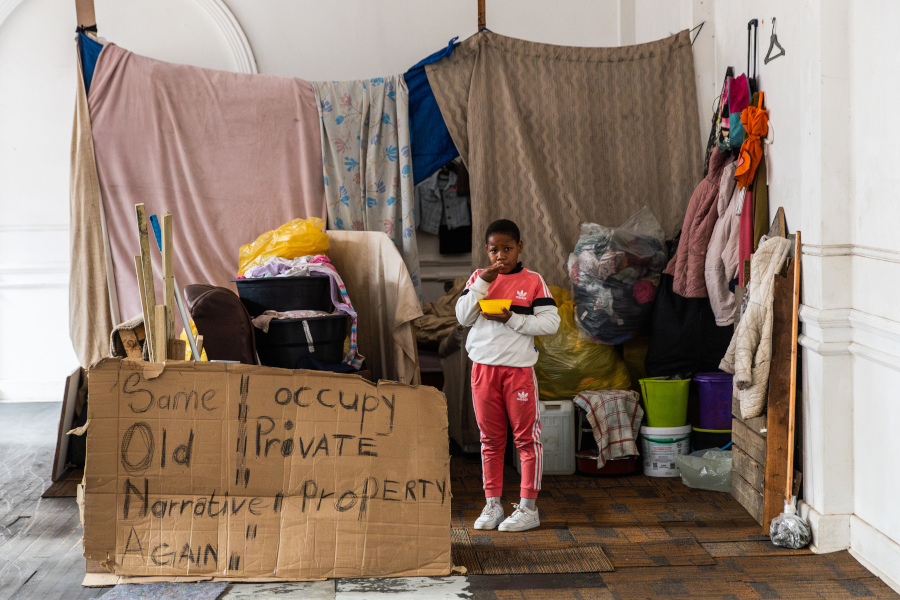
More than 150 people face eviction from three abandoned buildings in Hope Street
By Matthew Hirsch/GroundUp
Caroline Abrahams just turned 56 but says she has nothing to celebrate. She is one of over 150 people whose lives are in limbo as they face being evicted from three abandoned buildings in Cape Town’s Hope Street.
The buildings, owned by Hope Street Quarter, have been occupied since September last year. The buildings were in the process of being sold.
Some people who moved into the buildings had been sleeping in the nearby park. Many said they left communities such as Khayelitsha and Gugulethu to escape crime, gangs, and domestic violence. And others simply could not afford to pay rent anymore.
Abrahams became homeless as a teenager. She says she left home in Bonteheuwel after her father died and has battled to find steady work and housing ever since.
On 4 November 2025, a case of trespassing was opened at Cape Town police station. “The applicant’s rights, as owner of the properties, must be protected from unlawful action,” read the eviction application.
Hope Street Quarter stated that the properties had been sold to various third parties. Though the new owners have not been able to move in.
“There can be little doubt that the unlawful actions have resulted in damage to the property without any real prospect of recovery from the unlawful occupants.
“The properties are not designed nor registered to be used as residential occupation.”
The eviction case was heard in court in June 2026. About 37 of the occupiers are represented by housing movement, Ndifuna Ukwazi. The City of Cape Town was listed as a respondent.
Judgment was reserved.
Many of the people we spoke to say they have nowhere else to go should the eviction be granted.
The occupiers also complained that they are regularly targeted by “heavy-handed” police and private security.
According to court papers, the owners argue that the property is commercial and not suitable for human occupation.
“The unlawful occupiers are living in a dangerous and extremely volatile space. There is no electricity to the property, no running water, and there are no facilities to cook food.”
The evidence of commercial use was evident when we visited. One building appears to have previously been a storage facility, while another was an old garage.
Fundiswa Loza moved into the vacant properties after leaving her home in Gugulethu due to a family dispute.
She said they would like to make the property as homely as possible and do some repair work. However, not everyone can contribute due to their circumstances.
“We can’t keep staying in the periphery of the city, travelling long distances to come to school and work. We can’t keep repeating that cycle. That was from the apartheid era,” she said.
Loza said police recently started conducting raids in the building.
Mother of two, Nonceba Ndlebe has struggled to get a job in hospitality due to the cost of having to travel into the city centre from Khayelitsha. She said the high rate of crime and violence against women where she lived also motivated her decision to move.
She encouraged people to come and talk with them to understand why they occupied the buildings. She recalls hearing passers-by saying that they don’t belong there. “Those are the hurtful things, but we want to show them we are human. We are also citizens. We are people in need of a place to stay,” she said.
The City was listed as a respondent in the court case, because it has to provide emergency housing for the group should the eviction be granted.
The City told the court that it deals with up to 40 private evictions per week, all of which requires the municipality to conduct and submit a housing and means report.
“The extent of land and emergency housing units that is being requested of the City is overwhelming, and the City faces a massive emergency housing backlog,” the City’s court papers state.
Ward councillor Ian McMahon (DA) said children at the occupation often play in the busy street, raising safety concerns. McMahon said the health and safety of the people living there is the main concern. “Criminals often integrate into some of these properties and use it as a base, which paints the entire population living there badly. There has been such a long legal process in that area already.”
The property owners did not wish to comment while judgment has not been delivered.
Police were asked about the regular raids. They did not respond directly to the questions, but Constable Ndakhe Gwala said a 40-year-old man had been arrested on 2 July at the building. “As part of their crime prevention duties, police went inside an abandoned building in Hope Street where they were met by an aggressive suspect,” Gwala said.