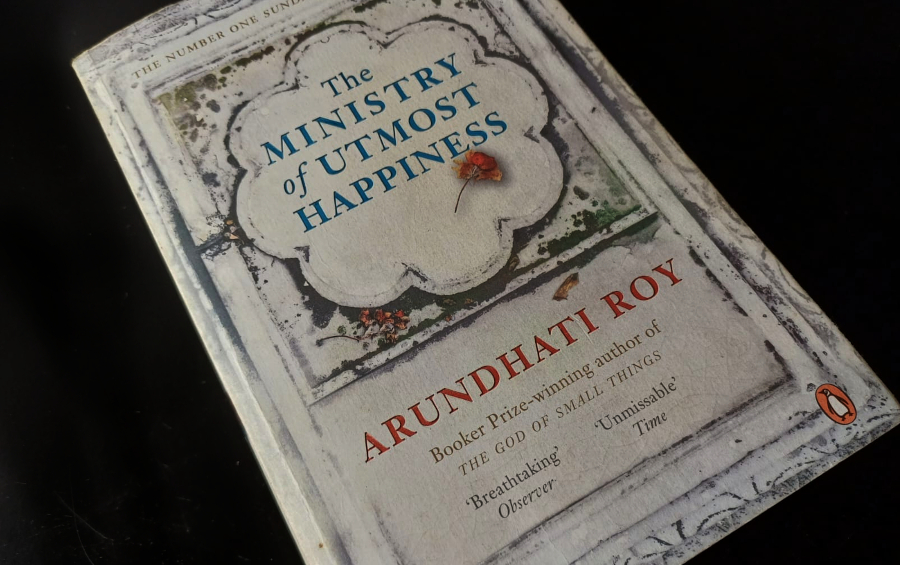
Arundhati Roy does not flinch from facing the void. Her second novel, The Ministry of Utmost Happiness, takes us deep into the contradictions within Indian society. Northern India at least, for the novel centres on Delhi, which in itself has a surfeit of human nature’s dark side. The most harrowing sections, however, occur when the scene shifts to Kashmir, formally known today as Jammu and Kashmir.
It’s not that Roy makes any effort to be morbid or bleak. In fact her writing is suffused with love and its power to both endure and sustain endurance.
She reports but does not dwell on the atrocities committed by India in it’s attempts to annex a determinedly resistant Kashmiri people. Nor does she ever attempt to enter the experience of being tortured, possibly because that experience is beyond imagination and even someone who has been tortured may struggle to convey what it feels like. The stark facts are enough to make a decently adjusted person to shiver with a subterranean fear.
Roy’s power is in the solidity of her scaffolding, trusting the reader to complete the room as they see fit. This is perhaps best illustrated when the character Tilo – who one suspects most closely resembles Roy herself – is marched into the room where Kashmiri militants are tortured, ironically in an old cinema, the location itself a mark of how India’s oppression has stripped life of joy and freedom. There, she simply notes the room and its lack of furniture. How it smells, what it contains; various tools on a workbench that could, should denote a workman’s workshop. But the pliers, for instance, are for pulling out fingernails. And the incongruous jar of chilli powder is used to stuff up anuses with an iron rod.
These things are haunting, hard to forget, although also educational in regard to India’s role in what amounts to the colonisation of Kashmir.
Equally, we are schooled on the Hindu attacks against Muslims within India; the mobs that erupt when politicians stoke the volcanoes of religious exclusivity and prejudice. Certainly, it is not the sanitised, romanticised India of Eat, Pray, Love and other saccharine books.
Roy feels trustworthy, that she presents what is real. And even when it feels as if what she is writing about is magical, there is no sentimentality in it. One believes it is true, and will be found if one looks in the right places, which are where most people don’t look.
But along with the atrocities Roy so sombrely – like a journalist – presents, what endures beyond their haunting is the depth and richness of her characters, along with the love between them. And again, Roy’s love is not sentimental, it is true; full of the foibles, faults, and misunderstandings that occur between humans. There is no doubt Roy has a rare understanding of human nature. Her writing, however objectively she notes life’s cruelties, is also deeply poetic in the way only profound observation stripped of romanticism can be.
This is clearly evident in the first chapter of her substantial novel in which Anjum, a hijra – Hindustani word for people who are hermaphrodites, intersex, eunuchs, and transgender – has a discussion with an old, blind imam in the graveyard she adopts as home:
“Then he narrowed his blindgreen eyes and asked in a slygreen whisper: ‘Tell me, you people, when you die, where do they bury you? Who bathes the bodies? Who says the prayers?’
Anjum said nothing for a long time. Then she leaned across and whispered back, untree-like, ‘imam Sahib, when people speak of colour – red, blue, orange, when they describe the sky at sunset, or moonrise during Ramzaan – what goes through your mind?’
having wounded each other thus, deeply, almost mortally, the two sat quietly side by side on someone’s sunny grave, haemorrhaging. Eventually it was Anjum who broke the silence.
‘You tell me,’ she said. ‘You’re the Imam Sahib, not me. Where do old birds go to die? Do they fall on us like stones from the sky? Do we stumble on their bodies in the streets? Do you not think that the All-seeing, Almighty One who put us on this Earth has made proper arrangements to take us away?’
That day the imam’s visit ended earlier than usual. Anjum watched him leave, tap-tap-tapping his way through the graves, his seeing-eye cane making music as it encountered the empty bottles and discarded syringes that littered his path. She didn’t stop him. She knew he’d be back. No matter how elaborate its charade, she recognized loneliness when she saw it. She sensed that in some strange tangential way, he needed her shade as much as she needed his. And she had learned from experience that Need was a warehouse that could accommodate a considerable amount of cruelty.”
The Ministry of Utmost Happiness was published in 2017. Roy’s third novel, Mother Mary Comes to Me, was published in 2025. Her first novel, The God of Small Things, was awarded the 1997 Booker Prize for Fiction.